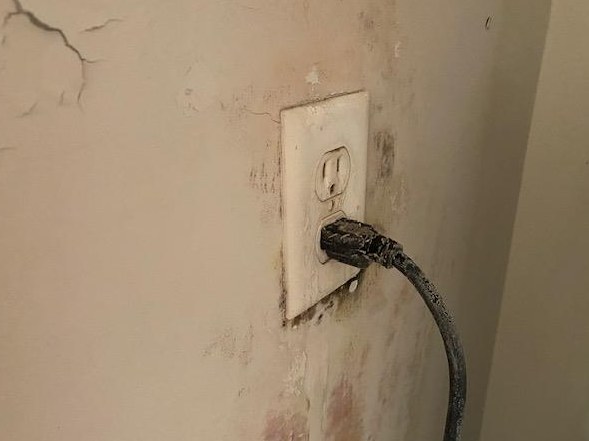

Mold does not have to be visible to affect the air in a home or apartment. Growth behind drywall, beneath flooring, inside wall cavities, or in a damp crawlspace can release spores and fragments that reach the rooms where people live. Peer-reviewed research shows how that happens: air moving through concealed building spaces carries fungal spores with it, and ordinary openings such as electrical outlets provide the path [1][2].
Many tenants and landlords assume that an intact-looking wall keeps hidden mold on its side. Walls, however, are rarely airtight. Electrical outlets, light switches, plumbing penetrations, baseboards, and construction joints all leave small openings, and the studies discussed below show that spores pass through such openings when air pressure pushes air from a concealed space into an occupied room [1][2].
Mold does not soak through solid drywall the way water soaks through a sponge. It grows on damp building materials, and its spores and fragments then travel through openings and connected air spaces. A typical framed wall contains concealed cavities holding wood studs, insulation, wiring, and plumbing, and those cavities are not sealed from the surrounding rooms. When air moves from a cavity into a room, it can carry airborne spores with it [1].
Researchers at the Helsinki University of Technology tested that process on a full-scale timber-frame structure. Airaksinen and colleagues released inert particles and spores of Penicillium and Cladosporium and varied the pressure difference and air leakage across the structure. Their measurements showed that fungal spores penetrated the structure, and that penetration depended heavily on the pressure difference rather than on holes in the surface boards [1].
The same study reported that particles between 0.6 and 2.5 micrometers penetrated at a roughly constant rate, while larger 4.0 micrometer particles passed through only where a direct flow path existed [1]. The authors concluded that sealing alone has difficulty stopping spore penetration through the building envelope. In their view, the only effective prevention appeared to be balancing or pressurizing the building [1].
Electrical outlets and switches deserve special attention because each one cuts an opening through the drywall into the cavity behind it. A cover plate may look like a seal, but gaps can remain around the electrical box, the wiring, and the plate itself. Researchers have tested exactly that question under laboratory conditions [2].
In a pilot study published in Environmental Monitoring and Assessment, Muise and colleagues at Indiana University built a wall chamber fitted with telephone, electrical, and cable outlets. They aerosolized spores of Penicillium chrysogenum into the chamber, held it under constant pressure, and captured the spores that passed through each outlet. The team ran thirty trials on each of five outlets, a total of 150 trials, and decontaminated the chamber between trials [2].
The results showed that wall service outlets allow spore penetration [2]. The telephone outlet let through significantly more spores than the others, and electrical outlets with plugs inserted performed no better than outlets without plugs. The researchers attributed the differences among outlets to differences in air leakage [2]. For a family living with mold behind a wall, the lesson is plain: an outlet cover does not wall off the cavity.
Field research points the same way. Japanese researchers studied concealed wall spaces in eighteen detached houses for a full year, collecting cavity air through the leaks around switch panels [4]. They described the possibility that mold in crawlspaces moves through concealed wall spaces and enters rooms through leaks in walls and outlets, and they evaluated concealed spaces as a source of indoor air pollution [4].
A Duke University team examined crawlspaces in 238 North Carolina homes and tested whether air leaking from heating, ventilation, and air conditioning (HVAC) systems carried viable mold spores from the crawlspace into the living space [3]. They found transmission in 19 percent of the homes, no transmission in 45 percent, and indeterminate results in 36 percent [3]. The authors concluded that the HVAC system can serve as a conduit for mold spores from the crawlspace into the home [3].
Floors present the same hidden-mold problem as walls. The United States Environmental Protection Agency (EPA) lists the underside of carpets and pads among the places where mold may hide [6]. The EPA also warns that absorbent or porous materials such as carpet may have to be thrown away if they become moldy [6]. A carpet that looks clean on top can therefore conceal growth on its backing and padding.
Iowa State University Extension explains that moisture on the surface of concrete floors can cause mold and mildew growth, wet rugs and carpet, and damp, musty smells [8]. It identifies four sources of that water: condensation, moisture migrating up through the slab from wet soil, broken or leaking pipes in or below the concrete, and surface water from leaks or flooding [8]. Each of those sources can wet a floor that no one sees beneath a carpet or rug.
Iowa State adds that carpet retards the flow of heat and moisture, so moisture can easily become trapped between the carpet and the concrete and take longer to dry than on a bare floor [8]. For that reason, the Extension advises never installing carpeting over floors that leak or have moisture migrating through them, and not carpeting wet areas [8]. It also cautions that a wood floor system and insulation built over concrete can trap moisture and cause mold, mildew, wood rot, and odor [8].
When water does reach a carpeted floor, the EPA’s guidance is specific. It calls for drying carpet and backing within 24 to 48 hours, and it states that the subfloor under the carpet or other flooring must also be cleaned and dried [7]. The EPA cautions that wet vacuums alone will not dry carpets; the carpet must come up for drying, and the padding must dry as well [9]. Even when materials dry within 48 hours, the EPA notes, mold growth may already have occurred [7].
Floors also connect to the spaces beneath them. The full-scale structure that Airaksinen and colleagues tested resembled a wooden floor, and spores passed through it when pressure pushed air across it [1][10]. In a house built over a crawlspace, the Duke findings show that ductwork can carry crawlspace spores into the rooms above as well [3]. A musty carpet over a damp slab or crawlspace calls for a look beneath it, not just a cleaning on top.
Each of these studies turns on air movement. The Helsinki researchers found that penetration rose and fell with the pressure difference across the structure [1]. They warned that mechanical exhaust ventilation, which depressurizes a building, deserves special care, because depressurizing may create a health risk when hazardous contamination exists in the building envelope [1]. The Duke study adds a second mechanism: leaking ductwork can carry crawlspace air, and the spores in it, into the living space [3].
That finding matters when a landlord points to a clean-looking wall. Visible surfaces tell only part of the story, and a sound assessment examines the cavities behind them. Our article on the tools mold assessors use explains wall cavity air sampling, borescopes, and moisture meters, and our article on basement and crawlspace mold explains how moisture builds up in concealed spaces.
A tenant who smells a musty odor or notices symptoms with no visible mold should not assume the walls are clean. The research above shows that outlets, switches, and other gaps can carry spores from a concealed cavity into the room [1][2]. Independent testing by an assessor who answers to the tenant, including sampling inside the wall cavity, can answer the question.
Under the Maryland Tenant Mold Protection Act, Real Property Article § 8-220, written notice of mold starts the landlord’s 15-day period to complete an assessment [5]. Our article on the Tenant Mold Protection Act explains those deadlines, and our article on the shortcuts landlords take describes what an inadequate response looks like. If new symptoms develop after exposure to mold or water-damaged building materials, including exposure you did not realize at the time, you should see a doctor.
Christopher L. Beard, an Annapolis attorney, concentrates his practice in toxic mold injury and habitability claims for Maryland tenants. If you have questions about mold in your home, e-mail chris@attorneybeard.com or call (410) 267-0227. You can also read more on Maryland mold laws or return to the attorneybeard.com home page.


