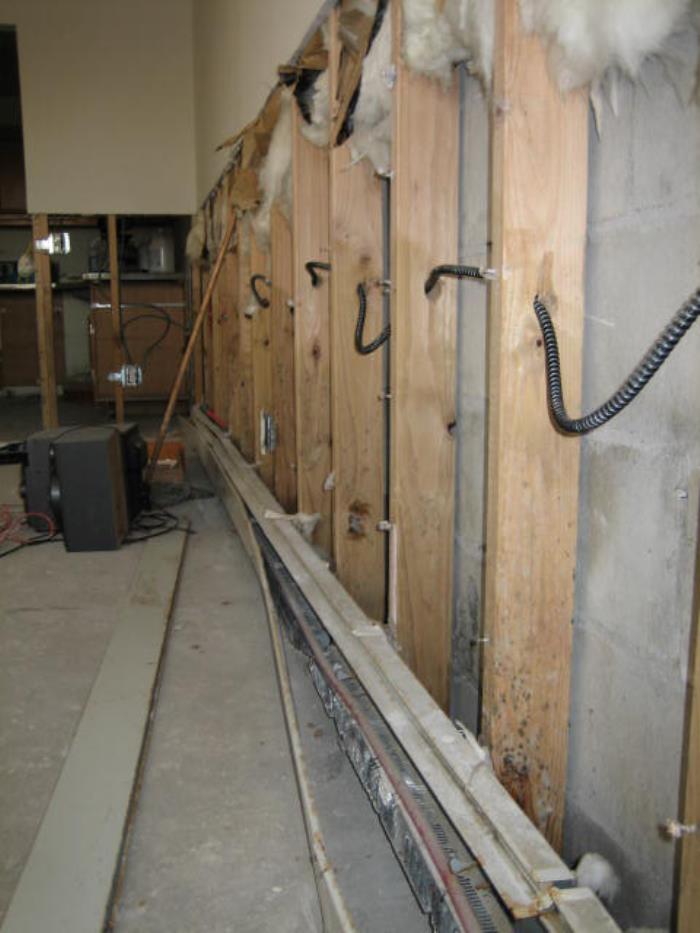

Many tenants assume mold requires a leak. The United States Environmental Protection Agency (EPA) teaches otherwise: the key to mold control is moisture control, and humid air can supply that moisture by itself [1]. Basements and crawlspaces collect water from the air, from the ground, and from groundwater that a failed sump pump no longer removes [2][3]. This article explains the science, and every figure in it comes from a numbered source listed at the end.
The National Weather Service defines relative humidity as the amount of moisture in the air compared with the amount the air would hold if it were saturated [5]. It defines the dew point as the temperature to which the air must cool to reach saturation [5]. The Massachusetts Department of Public Health explains that when a building material is colder than the dew point, condensation accumulates on that material [6].
The practical rule follows directly: the surfaces that collect water are the ones colder than the dew point [6]. Harvard University’s Environmental Health and Safety office identifies the cool foundation walls and slab as the surfaces where basement air condenses [3]. Those surfaces become wet without any leaking pipe or rain [3][4].
The examples below come from public health agencies and building science publications. Each gives the dew point for a combination of air temperature and relative humidity, which is the surface temperature at which condensation begins [6]. An assessor compares that figure with the measured temperature of the walls and floor, as the Massachusetts Department of Public Health did with a laser thermometer in the assessment cited below [6].
The last example matters most for basements. The Air Infiltration and Ventilation Centre applied it to a basement floor in summer, and condensation forms wherever the floor sits below the dew point of the air [8]. The Connecticut Department of Public Health notes that the earth cools below-grade basement walls, sometimes below the dew point [4]. Hot, humid summer air therefore meets surfaces cold enough to make it condense.
The EPA recommends keeping indoor relative humidity below 60 percent, and ideally between 30 and 50 percent [1]. The United States Department of Energy (DOE), in its Building America guide to crawlspaces, uses the same 30 to 50 percent range for the space beneath a house [2]. The Connecticut Department of Public Health likewise advises keeping basement humidity below 60 percent and checking it with a hygrometer [4].
Building scientists also measure humidity at the surface itself. ASHRAE Standard 160, published by the American Society of Heating, Refrigerating and Air-Conditioning Engineers (ASHRAE), originally set its mold criterion as a 30-day average surface relative humidity below 80 percent [10][13]. A 2016 addendum substituted a more detailed mold growth model [13], but ASHRAE’s 2024 ventilation standard addendum still refers to the 80 percent, 30-day benchmark [11].
Public health agencies use a lower warning line for room air. The Massachusetts Department of Public Health, citing ASHRAE, cautions that mold growth may occur when relative humidity exceeds 70 percent, because building materials become wet [7]. The same agency notes that relative humidity above 70 percent over a long period can damage susceptible materials even without condensation or liquid water [6].
A basement sits inside the earth, and the earth stays cool. The Connecticut Department of Public Health explains that dehumidifiers belong in basements because the walls sit below grade and the earth cools them [4]. Harvard describes the summer pattern: when basement air is not conditioned or dehumidified, the moist air warms in hot weather and condenses on the cool foundation and slab, creating a microenvironment favorable to mold [3].
Groundwater adds a second source. Harvard notes that moisture from outside the foundation and beneath the slab naturally moves into the basement [3]. The DOE guide explains that water wicks through porous materials and small cracks by capillary action, with rain and groundwater as the primary sources [2].
Finishing a basement often makes matters worse. Harvard warns that a finished basement can create a microenvironment between the finished wall and the foundation that strongly favors mold growth [3]. Harvard recommends appropriate thermal and vapor barriers to prevent condensation on those surfaces [3].
The DOE guide reports research showing that vented crawlspaces in mixed or hot-humid climates tend to raise the moisture level beneath the house rather than drying it [2]. That moisture condenses on the cooler wood surfaces of the floor framing and promotes fungal growth and wood damage [2]. The guide adds that finding traces of mold in a poorly detailed and ventilated crawlspace is common [2].
The same guide treats the ground itself as a moisture source. It calls for covering the entire crawlspace floor with a sealed polyethylene vapor barrier, sealing the foundation vents, and conditioning or dehumidifying the space to 30 to 50 percent relative humidity [2]. It also treats moisture content above 17 percent in crawlspace wood as a concern that requires investigation [2].
The DOE guide identifies unsealed penetrations and joints between conditioned and unconditioned areas as paths for air carrying water vapor [2]. It calls for sealing every gap around water, electrical, plumbing, and duct penetrations before the work is complete [2]. It also lists mold on crawlspace framing as a stop-work item that requires a mold remediation professional [2].
A sump pump sits in a pit in some basements and crawlspaces. The University of Georgia Cooperative Extension describes it as a pump used to move water away from the house, and its checklist directs homeowners to confirm that the pump works and the floor drain is intact [12]. The International Residential Code, as quoted in the DOE guide, requires a sump in many soils to drain the porous layer beneath the floor and the footings [2].
The DOE guide recommends a battery backup for the pump in areas with high water tables, to keep drainage running during power outages [2]. It also recommends a water leak alarm at a low spot or near the drain, because unwanted water on the floor may otherwise go unrecognized for long periods [2]. A pump without power or backup leaves standing water, which the guide treats as a stop-work condition until someone corrects the source [2].
An open sump pit causes trouble even when the pump runs. The DOE guide warns that missing or unsealed lids allow moisture to enter and raise the relative humidity, and it calls for a tight, sealed lid [2]. Once water does cover the floor, the EPA advises drying water-damaged areas and items within 24 to 48 hours to prevent mold growth [1].
The DOE guide lists measures that keep water away from a foundation in the first place. Roof runoff should discharge at least 10 feet from the building or through an underground drain, and the ground should slope away from the foundation at 5 percent, or six inches over the first ten feet [2]. Sprinkler flow must point away from the home [2].
Inside, the same guide calls for a working sump with a sealed lid, a backup where the water table is high, a sealed vapor barrier, and humidity held between 30 and 50 percent [2]. Harvard recommends holding relative humidity below 60 percent, with 30 to 50 percent preferred [3]. A landlord who keeps up these measures leaves a record of maintenance; a landlord who does not leaves a record of neglect.
Condensation leaves no broken pipe to point to, so the assessor builds the case from measurements. Harvard describes assessing surfaces and materials with a moisture meter and measuring relative humidity to evaluate areas of potential condensation [3]. The Massachusetts Department of Public Health measured basement wall and floor temperatures with a laser thermometer alongside air temperature and relative humidity [6].
Comparing the surface temperature with the dew point of the air shows whether condensation will form [6]. A moisture meter then shows whether the wood exceeds the 17 percent figure in the DOE guide [2]. The DOE guide also suggests a humidistat to track conditions over time [2], and readings over time matter because the ASHRAE benchmark rests on a 30-day average [10].
The Connecticut Department of Public Health recommends using a hygrometer to check relative humidity and keep it below 60 percent [4]. A tenant who keeps a dated log of those readings, with photographs of any water or growth, has a record no one can dispute. Under the Maryland Tenant Mold Protection Act, Real Property Article § 8-220, written notice of mold starts the landlord’s 15-day period to complete an assessment [14].
If new symptoms develop after exposure to mold or water-damaged building materials, including exposure you did not realize at the time, you should see a doctor. A tenant who doubts the landlord’s response can arrange independent testing by an assessor who answers to the tenant. Measurements taken before anyone cleans or paints preserve the conditions as they existed.
Christopher L. Beard, an Annapolis attorney, concentrates his practice in toxic mold injury and habitability claims for Maryland tenants. If you have questions about mold in your home, e-mail chris@attorneybeard.com or call (410) 267-0227. You can also read our article on the Maryland Tenant Mold Protection Act.
For more on how professionals test and clean a moldy home, read Tools of the Trade and Cutting Corners: The Mold Shortcuts Landlords Take. You can also return to the attorneybeard.com home page.
Banner photograph: mold on exposed wall framing in a flooded home after Hurricane Sandy. Centers for Disease Control and Prevention (CDC) Public Health Image Library, photo by Ginger Chew, ScD, phil.cdc.gov.


